Basis Lab

The mathematics underneath

Count how many ways something can happen without writing them all out, and recognise that count as the denominator sitting under every probability you will later meet

Counting Without Listing
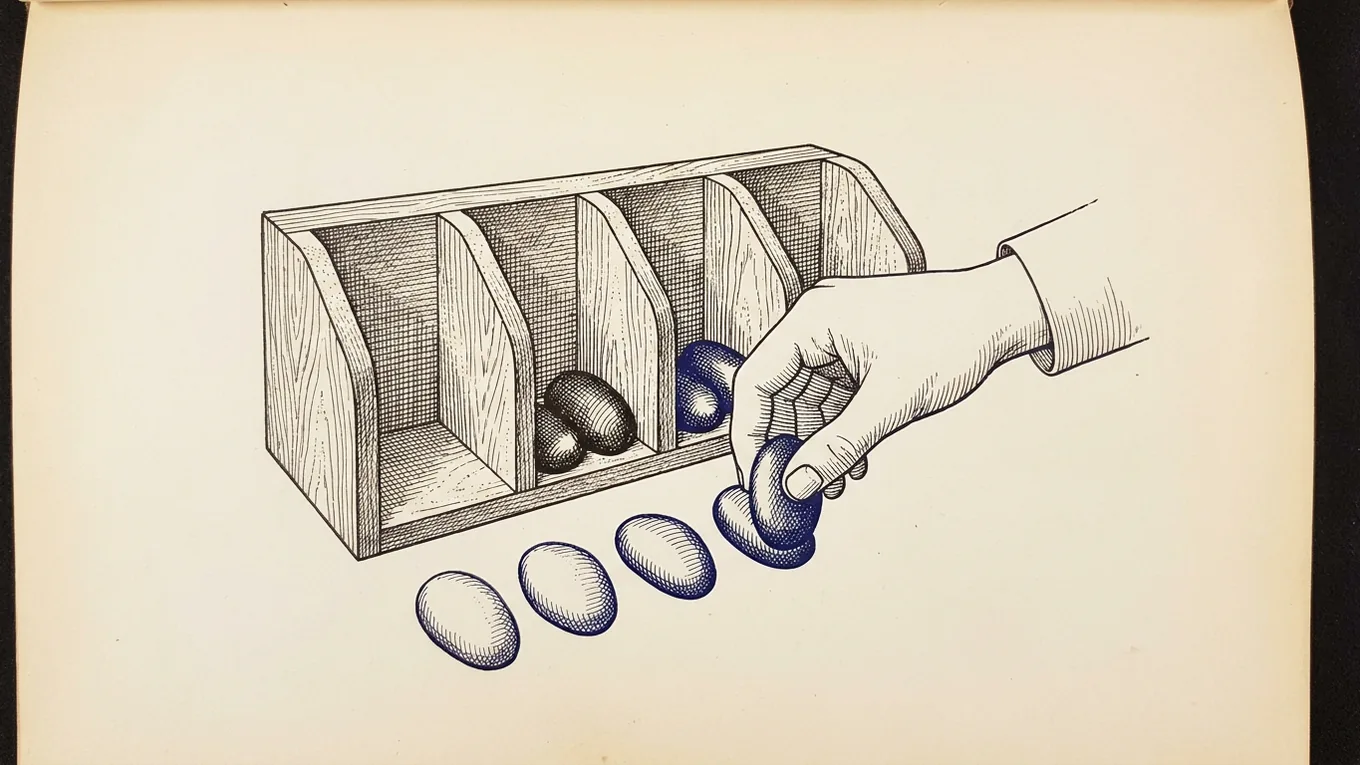
Arrangements, choices, and the difference between them. The counting that probability is built on, derived from one rule about doing one thing after another.

8 lessons, written and corrected before you arrived. Reading them here needs no account. The first reads the whole way through; the others open and then stop, because a page nobody owns cannot tell who is reading it. Starting the course gives you your own copy, where every idea has problems standing under it and you can ask about any sentence.

Start reading

This is course 3 of 8 in a reading track: read any page here without stopping at the symbols. The track is an order, not a gate, and the rest of it is on one page.

  1. 01One Choice After AnotherEverything in counting comes from one rule: choices made one after another multiply. The rule is obvious, its condition is not, and the condition is where every counting error begins.
  2. 02Putting Things in Orderopening onlyApply the multiplication rule until the pile runs out and the factorial appears. It is the fastest growing count in ordinary use, and it is why some problems can never be solved by trying everything.
  3. 03When Order Does Not Matteropening onlyCount the arrangements, then divide out the orderings you did not want. That one move turns the factorial into the choose count, which is the number sitting under most of probability.
  4. 04Putting It Back, or Notopening onlyDrawing with the item returned each time gives a power; drawing without gives a falling product. The two answers agree when the pile is large and diverge alarmingly when it is not.
  5. 05Counting Turns Into Chanceopening onlyA probability is a count divided by a count. The division is easy; the work is making sure both halves count the same kind of thing and that the outcomes really are equally likely.
  6. 06Counting the Same Thing Twiceopening onlyTwo errors account for most wrong counts: counting an outcome more than once, and forgetting that two groups overlap. Both have a standard repair and both are detectable on a small case.
  7. 07More Things Than Placesopening onlyIf there are more things than places, two of them share. The certain version is obvious; the probable version arrives far sooner than intuition allows, and it is why collisions must be designed for.
  8. 08When Counting Explodesopening onlyPolynomial, exponential and factorial counts separate so violently that the gap decides what can be computed at all, and no faster machine closes it.