Basis Lab

The mathematics underneath

Take any recorded signal apart into the steady rhythms it is made of, say exactly what that costs and what it preserves, and read a spectrum well enough to know which of its features belong to the signal and which were put there by the act of measuring it

The Fourier Transform
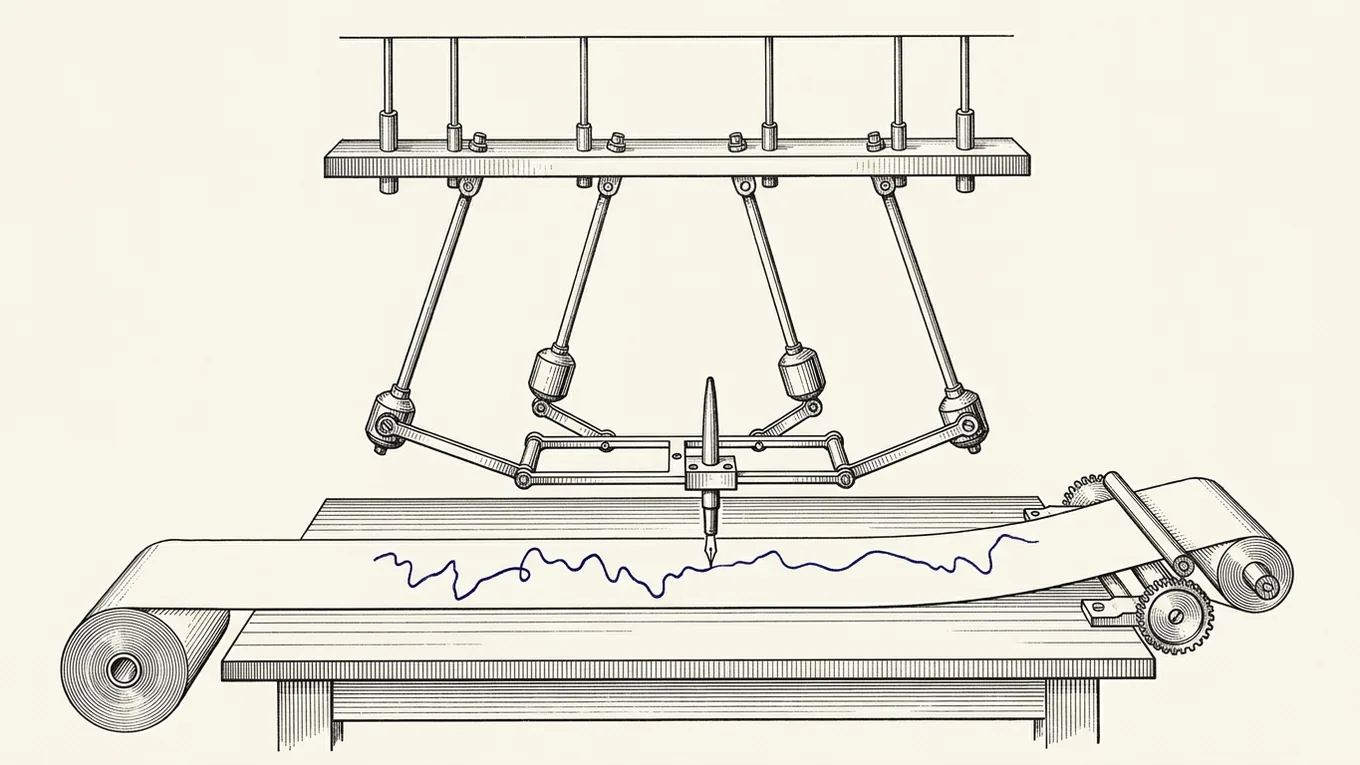
Every list of numbers can be written as a sum of steady rhythms. This course derives the recipe that finds them, the one property that makes the whole subject worth the trouble, and the three ways a spectrum lies to you.

8 lessons, written and corrected before you arrived. Reading them here needs no account. The first reads the whole way through; the others open and then stop, because a page nobody owns cannot tell who is reading it. Starting the course gives you your own copy, where every idea has problems standing under it and you can ask about any sentence.

Start reading

  1. 01One Signal, Two DescriptionsA recording can be written as a list of values in time order, or as a list of rhythms with an amount beside each. Both hold everything, and each makes a different question easy.
  2. 02Asking a Signal How Much of One Rhythm It Holdsopening onlyMultiply the signal by the rhythm you are asking about and add up the result. The answer is the amount of that rhythm, and every other rhythm in the signal contributes exactly nothing.
  3. 03Two Numbers for Every Rhythmopening onlyA cosine probe returns nothing for a rhythm that is fully present but shifted a quarter cycle. The repair is to ask twice, and the pair of answers is a turning arrow with a length and a direction.
  4. 04The Transform of a Finite Listopening onlyWith both probes bundled into one turning arrow, the transform of a list of readings is a single finite sum. It inverts exactly, and the count of numbers balances on both sides.
  5. 05Sliding Becomes Multiplyingopening onlyEvery filter, blur and echo slides one signal along another and adds up the overlap. In the second description that whole operation becomes one multiplication per rhythm.
  6. 06What Was Lost Before You Startedopening onlyMeasuring at regular instants makes whole families of rhythms identical. Which ones collapse together follows from one line of arithmetic, and no later processing can separate them again.
  7. 07The Price of Looking for a Finite Timeopening onlyA transform computed from a finite record is the transform of the signal multiplied by the record. That spreads every pure rhythm across neighbouring rates, and there are two cures.
  8. 08The Algorithm That Made It Practicalopening onlyThe honest sum costs the square of the length. Splitting the readings into evens and odds turns it into two half transforms and one combining pass, and repeating that is the whole algorithm.