Basis Lab

How models work

Get something useful out of data nobody has labelled, by grouping it, by reducing it to fewer numbers, and by flagging the parts that do not look like the rest, and judge those results honestly given there is no right answer to check against

Finding Structure Without Labels
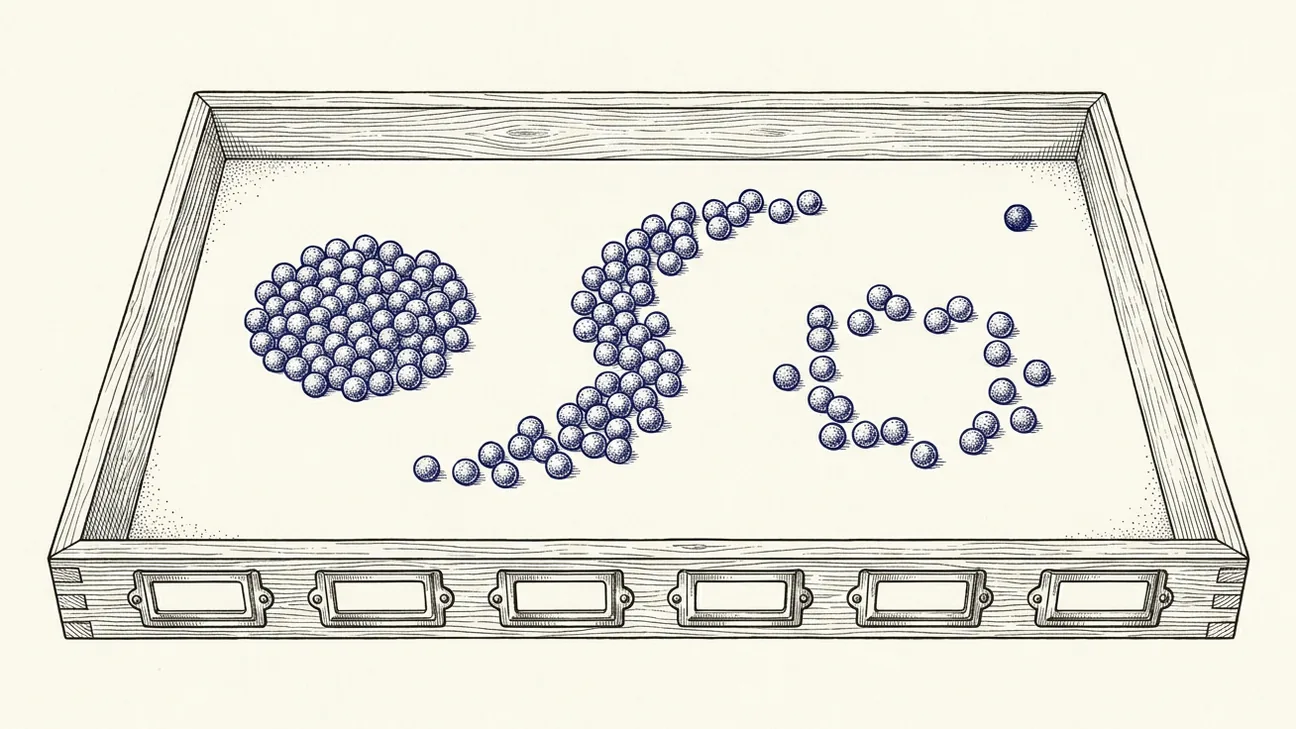
What to do when nothing is labelled. Grouping, compressing and spotting the odd one out, and the harder problem of knowing whether any of it worked.

8 lessons, written and corrected before you arrived. Reading them here needs no account. The first reads the whole way through; the others open and then stop, because a page nobody owns cannot tell who is reading it. Starting the course gives you your own copy, where every idea has problems standing under it and you can ask about any sentence.

Start reading

This is course 8 of 8 in a reading track: build a model by hand, then find the same parts inside every large one. The track is an order, not a gate, and the rest of it is on one page.

  1. 01Working Without an Answer KeyThree useful questions can be asked of data nobody has labelled, none of them has a score to check against, and every method answers whether or not there is anything there.
  2. 02Deciding What Close Meansopening onlyEvery method here is built on a notion of distance, and choosing it, including the scales of the inputs, decides more of the answer than the choice of method does.
  3. 03Grouping Around Centresopening onlyAlternating between assigning each point to its nearest centre and moving each centre to the average of its points is the most used grouping method there is, and its shape assumption is built in.
  4. 04How Many Groups Are Thereopening onlyThe number of groups has to be argued for, and the usual argument is a bend in a falling curve, which is vague, so the better one compares the data against the same data with its structure destroyed.
  5. 05Groups That Are Not Blobsopening onlyGrouping by how crowded a neighbourhood is finds groups of any shape, leaves points unassigned rather than forcing them somewhere, and needs no number of groups chosen in advance.
  6. 06Describing It With Fewer Numbersopening onlyMost wide tables really vary along a handful of directions, and finding those directions replaces sixty columns with three while recording exactly how much was thrown away.
  7. 07Flagging the Odd One Outopening onlyScoring how unusual a row is can be done three ways, and the threshold on that score is not a statistical question but an arithmetic one about what a false alarm costs.
  8. 08Judging a Result With No Truth to Checkopening onlyTwo tests carry almost all the honest evidence available here, whether the result survives being refitted on different rows and whether it predicts something deliberately kept out of it.