The library

The physics underneath

Take any system that repeats and break it into the handful of shapes that each move at a single rate, in enough detail to predict what it will do next and to say which of its rhythms a push will feed

Waves, Modes and Frequency
Oscillation from one mass on a spring to a wave with nothing to travel in. Each lesson finds the shapes that move at a single rate, adds them back up, and watches a stepped calculation keep the total it is supposed to keep.

8 lessons, written and corrected before you arrived. Reading them here needs no account. The first reads the whole way through; the others open and then stop, because a page nobody owns cannot tell who is reading it. Starting the course gives you your own copy, where every idea has problems standing under it and you can ask about any sentence.

Start reading

  1. 01The One Rhythm Nearly Everything Falls IntoAnything resting at the bottom of an energy curve behaves like a weight on a spring, because every curve looks like a parabola close up. That is why so many unrelated systems share one rhythm.
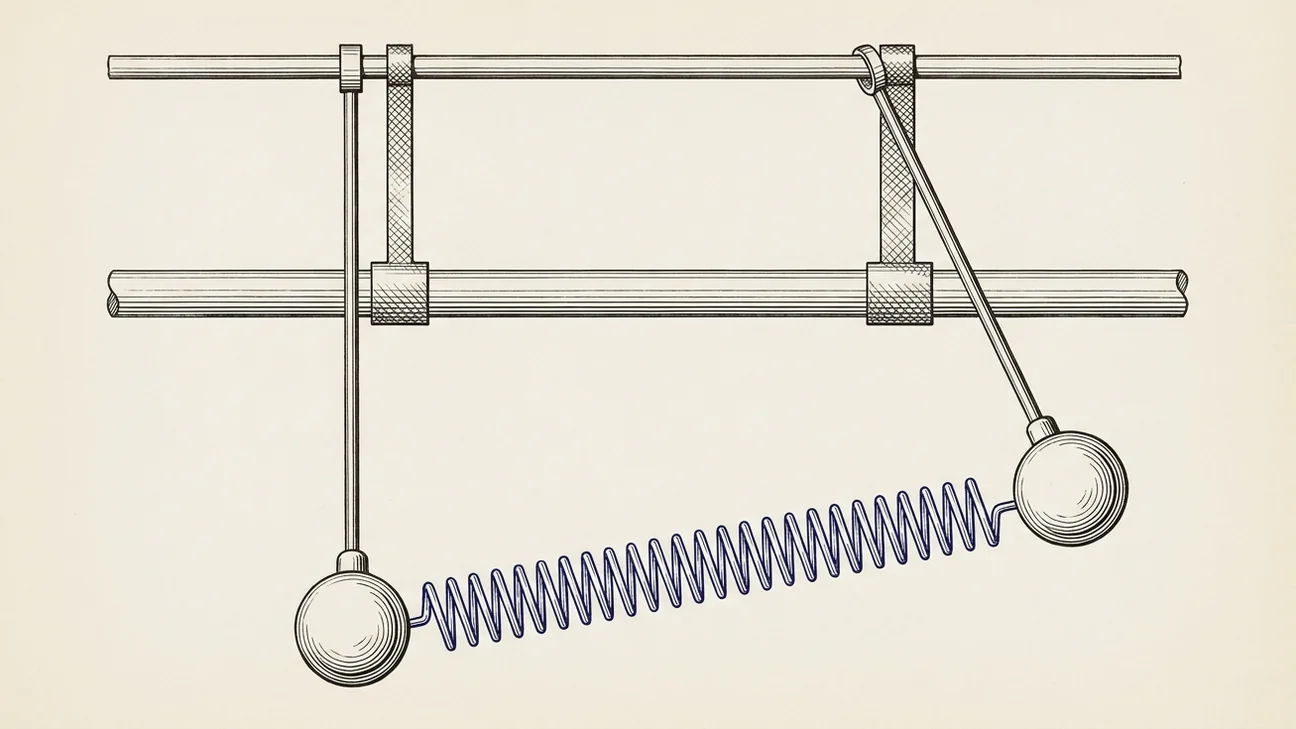
  2. 02Two Joined Pendulums and the Two Rhythms Hiding in Themopening onlyJoin two pendulums with a spring and the motion looks irregular, with the swing migrating from one to the other. Two combinations of them turn out to be perfectly regular.
  3. 03What a Clamped String Is Allowed to Doopening onlyA string is many small pieces each pulling on its neighbours, so it has many of the combinations from the last lesson. Clamping both ends decides exactly which shapes are allowed.
  4. 04Every Starting Shape Is a Sum of the Allowed Onesopening onlyA plucked string starts with a corner in it, which is not an allowed shape. It is a sum of allowed shapes, and that single fact turns the list of shapes into a complete method.
  5. 05A Travelling Wave Is Two Standing Onesopening onlyThe shapes of a clamped string stand still and swell. A disturbance on a long rope travels. Adding two standing shapes a quarter turn apart produces one that moves.
  6. 06Pushing at the Rate a Thing Already Hasopening onlyPush an oscillator at its own rate and small pushes accumulate into a large swing. The response is sharp or blunt depending on how fast the system loses what it is given.
  7. 07The Ring That Forgetsopening onlyHeat spreading round a ring uses the same shapes as a vibrating string, but they decay instead of oscillating, and the fine detail decays first. What survives is a single number.
  8. 08Charges, Loops and a Wave With Nothing to Waveopening onlyTwo rules about loops say that a changing magnetic field makes an electric one and a changing electric field makes a magnetic one. Together they force a wave with no medium.