The library

The mathematics underneath

Treat anything that changes over time as a state plus a rule that advances it, find where it would sit still, decide whether it would stay there, and say what the long run looks like without solving anything exactly

Systems That Evolve
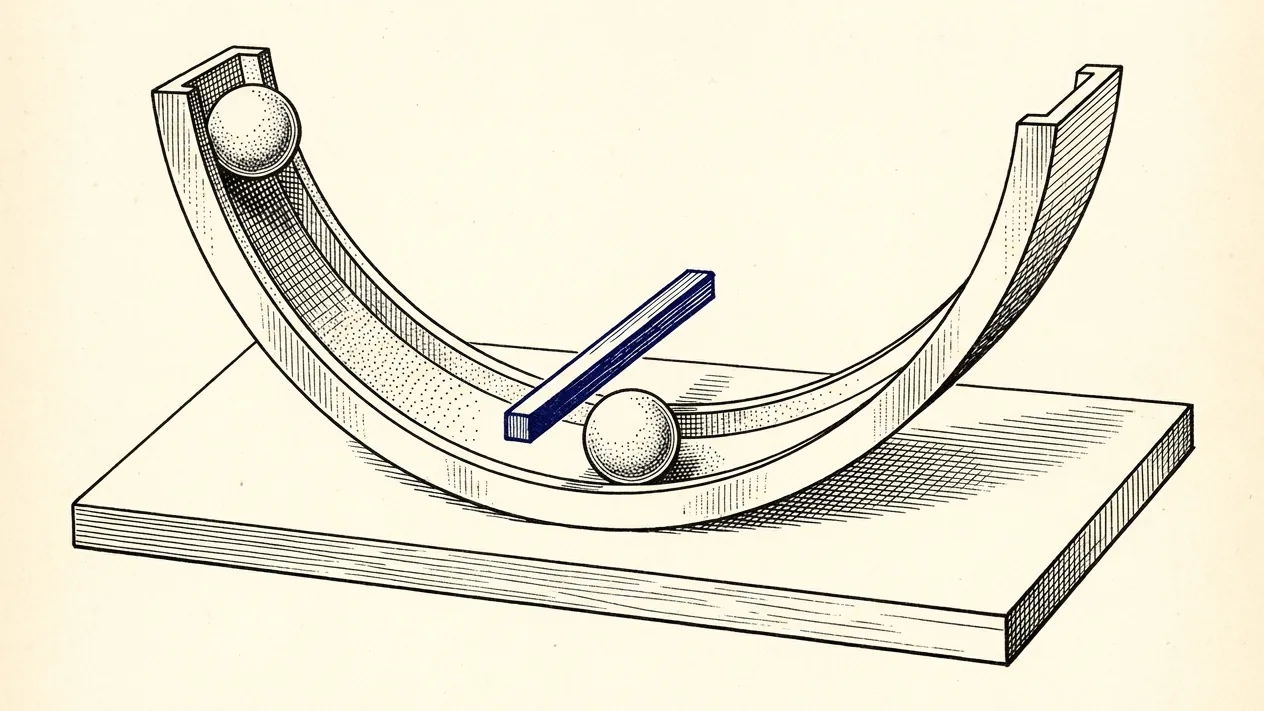
A state, a rule that advances it, and the questions you can answer without ever solving it. Where it rests, whether it stays there, whether it circles, and how far ahead it can be trusted.

8 lessons, written and corrected before you arrived. Reading them here needs no account. The first reads the whole way through; the others open and then stop, because a page nobody owns cannot tell who is reading it. Starting the course gives you your own copy, where every idea has problems standing under it and you can ask about any sentence.

Start reading

  1. 01A State and a RuleAnything that changes over time can be written as a list of numbers describing how things stand now, plus a rule that turns that list into the next one. Choosing the list is the real work.
  2. 02Where Nothing Movesopening onlyA resting state is one at which every rate is zero at once, so the system left there stays there. Finding them is algebra, not simulation, and it is the first thing worth doing to any rule.
  3. 03Nudge It, and See Whether It Comes Backopening onlyDisplace a system slightly from a resting state and the rule either shrinks the displacement or grows it. The deciding quantity is the slope of the rate, and its sign is the answer.
  4. 04Drawing the States Instead of the Clockopening onlyPlot the two numbers of a state against each other instead of against time. The clock disappears, a history becomes one curve, and the fact that curves cannot cross decides a great deal.
  5. 05Round and Round, and What Holds It Thereopening onlyThe valley neither settles nor runs away. It circles, because a particular combination of the two counts never changes, which confines the state to a closed curve it cannot leave.
  6. 06Many Parts, One Totalopening onlyA state with five numbers instead of two changes nothing about the method. One local rule, plus a total that cannot move, settles where the whole thing ends up before a step is taken.
  7. 07When Small Differences Growopening onlySome rules multiply the distance between two nearby starts by a fixed factor every step. Nothing is random, yet the honest forecast horizon grows only with the logarithm of your precision.
  8. 08How Far to Trust a Long Runopening onlyA walk forward is not the rule, and the rule is not the world. Two separate audits are needed, one on the arithmetic and one on the modelling, each with a test you can run first.